

Books





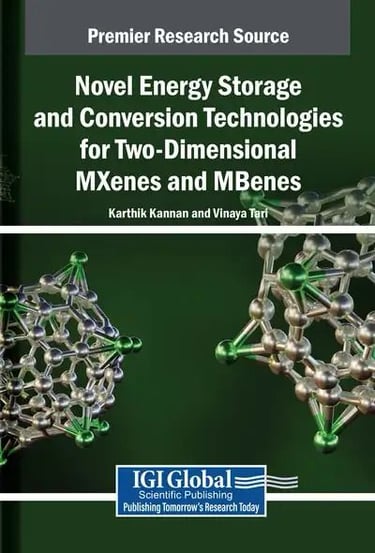
Novel Energy Storage and Conversion Technologies for Two-dimensional MXenes and MBenes
Editors: Karthik Kannan and Vinaya Tari
This book, Novel Energy Storage and Conversion Technologies for Two-dimensional MXenes and MBenes, aims to provide an in- depth exploration of these materials and their potential to revolutionize various energy- related technologies. The chapters within this book cover a wide range of topics, from the fundamental principles of MXenes and MBenes to their applications in energy storage devices such as supercapacitors, batteries, and hydrogen production systems. Additionally, the contributions explore the latest innovations in the synthesis, characterization, and optimization of these materials, offering valuable insights into the challenges and opportunities that lie ahead.
Buy now:
https://www.amazon.com/Energy-Storage-Conversion-Technologies-Two-dimensional/dp/B0F512LCL2
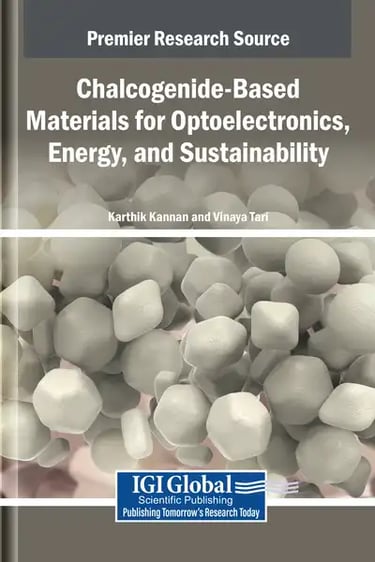
Chalcogenide-Based Materials for Optoelectronics, Energy and Sustainability
Editors: Karthik Kannan and Vinaya Tari
The book brings together a wide spectrum of chalcogenide-based systems, including transition metal chalcogenides, bimetallic chalcogenides, perovskites, and hybrid nanocomposites. Their applications are equally diverse: from solar cells, photodetectors, and LEDs to neuromorphic devices, batteries, fuel cells, super capacitors, and water- splitting catalysts. In environmental contexts, their unique properties - particularly at the nanoscale offer promising solutions for wastewater treatment and pollution control through enhanced photocatalytic activity.
Buy now:
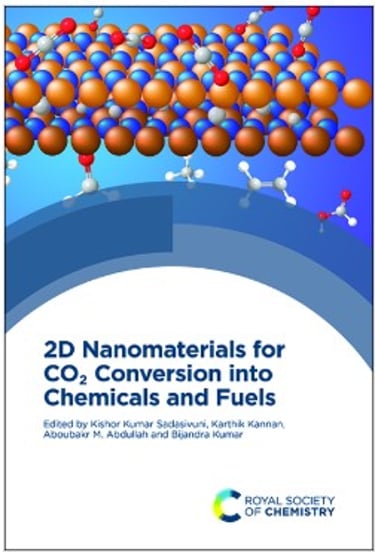
2D Nanomaterials for CO2 Conversion into Chemicals and Fuels
Editors: Kishor Kumar Sadasivuni, Karthik Kannan, Aboubakr M. Abdullah, & Bijandra Kumar
Since the discovery of graphene, two-dimensional nanomaterials, including Transition metal dichalcogenides (TMDCs), Hexagonal Boron Nitride (hBN), non-layered compounds, black phosphorous, and Xenes with large lateral dimensions, have emerged as promising candidates for heterogeneous electrocatalysis owing to their exceptional physical, chemical, and electronic properties. Covering the fundamentals, properties, and applications, this work discusses all aspects of 2D nanomaterial composites in carbon dioxide conversion. The industrial scale-up and new challenges that exist in the field of electrochemical reduction of carbon dioxide will also be presented. With chapters written by internationally recognized researchers, this state-of-the-art overview will serve the growing interest amongst academic and industrial researchers in understanding 2D nanomaterials composites, their hidden interfaces and nanoscale dispersion of the metal oxide with nanocomposites for specific uses in carbon dioxide conversion to chemicals for fuel applications. This book will be of interest to graduate students and researchers in materials science, energy, and environmental science, as well as those in industry.
Buy now:
Amazon.com: 2D Nanomaterials for CO2 Conversion into Chemicals and Fuels: 9781839163111: Sadasivuni, Kishor Kumar, Kannan, Karthik, Abdullah, Aboubakr M, Kumar, Bijandra: Books
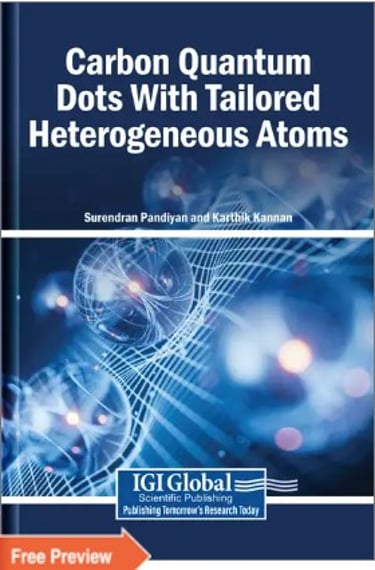
Carbon Quantum Dots With Tailored Heterogeneous Atoms
Editors: Surendran Pandiyan and Karthik Kannan
Carbon quantum dots with tailored heterogeneous atoms have emerged as a cutting-edge class of nanomaterials distinguished by their tunable electronic structures and versatile chemical functionalities. By introducing heteroatoms such as nitrogen, sulfur or phosphorus, into the carbon lattice, researchers can precisely modulate the surface states and bandgap of carbon quantum dots, thereby enhancing their optical and electrical performance. This atomic-level engineering not only deepens the understanding of quantum confinement and defect chemistry in carbon-based nanostructures but also paves the way for advanced applications in bioimaging and energy conversion. As a result, heteroatom-doped carbon quantum dots represent a promising frontier in nanoscience. Carbon Quantum Dots With Tailored Heterogeneous Atoms explore carbon quantum dots that doped with heterogeneous atoms to enhance their properties. This book explains the intricate role of heteroatom doping in enhancing the functionality of carbon quantum dots. Covering topics such as nanotechnology, material science, and nitrogen atoms, this book is an excellent resource for academicians, industry professionals, scientists, and graduate students.
Buy now:
https://www.amazon.com/-/zh_TW/Surendran-Pandiyan/dp/B0G56FV2RL